What Happens to the Mother's Heart During Pregnancy How a Baby Grows Movie
Baronial 28, 2015
Editor's note: This story is existence highlighted in ASU Now's yr in review. To read more top stories from 2015, click hither.
Parents go to groovy lengths to ensure the health and well-being of their developing offspring. The favor, however, may not always exist returned. 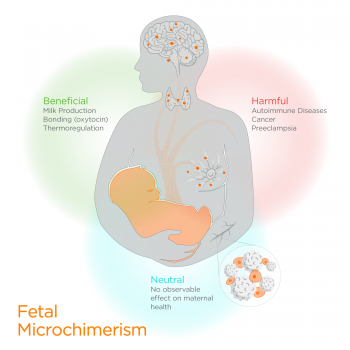 Dramatic enquiry has shown that during pregnancy, cells of the fetus often migrate through the placenta, taking upward residence in many areas of the female parent's body, where their influence may benefit or undermine maternal health. Photo by: Jason Drees/Biodesign Constitute Download Total Image
Dramatic enquiry has shown that during pregnancy, cells of the fetus oftentimes migrate through the placenta, taking up residence in many areas of the mother's trunk, where their influence may benefit or undermine maternal health.
The presence of fetal cells in maternal tissue is known as fetal microchimerism. The term alludes to the chimeras of ancient Greek myth — blended creatures built from different animal parts, similar the caprine animal-lion-ophidian depicted in an Etruscan bronze sculpture.
According to Amy Boddy, a researcher at Arizona State University's Department of Psychology and pb author of a new study, chimeras be. Indeed, many humans bear chimerical traits in the course of foreign cells from parents, siblings or offspring, caused during pregnancy.
"Fetal cells tin human action as stalk cells and develop into epithelial cells, specialized eye cells, liver cells and and so along. This shows that they are very dynamic and play a huge role in the maternal body. They can fifty-fifty drift to the brain and differentiate into neurons," Boddy said. "Nosotros are all chimeras."
Young man ASU researchers Angelo Fortunato, Melissa Wilson Sayres and Athena Aktipis joined Boddy for the new written report. Fortunato is with the Biodesign Found's Human and Comparative Genomics Lab. Wilson Sayres and Aktipis — both with Biodesign's Center for Development and Medicine — are also researchers with ASU'south School of Life Sciences and Department of Psychology, respectively.
Mother'southward picayune helpers?
Although fetal microchimerism is a common occurrence across placental mammals (including humans), the effects of such cells on maternal wellness remain a topic of tearing debate in the biological customs.
In research appearing in the advanced online edition of the journal Bioessays, Boddy and her colleagues review the available literature on fetal microchimerism and human health, applying an evolutionary framework to predict when fetal cells are inclined to act cooperatively to enhance maternal wellness and when their beliefs is probable to be competitive, occasionally leading to adverse furnishings on the mother.
Fetal cells may exercise more than only migrate to maternal tissues. The authors suggest they can deed as a sort of placenta outside the womb, redirecting essential avails from the maternal trunk to the developing fetus. Cells derived from the fetus — which tin can persist in maternal tissues for decades after a child is born — have been associated with both protection and increased susceptibility to a range of afflictions, including cancer and autoimmune diseases like rheumatoid arthritis.
But, as co-author Wilson Sayres, cautions, "information technology's not only a tug of war between maternal and fetal interests. There is also a common desire for the maternal system to survive and provide nutrients and for the fetal organisation to survive and pass on DNA."
If some degree of fetal microchimerism exerts a benign consequence on maternal and offspring survival, it volition likely be selected by evolution as an adaptive strategy.
A review of existing data on fetal microchimerism and health suggests that fetal cells enter a cooperative relationship in some maternal tissues, compete for resource in other tissues and may exist as neutral entities — hitchhikers simply along for the ride. It is likely that fetal cells play each of these roles at diverse times.
For example, fetal cells may contribute to inflammatory responses and autoimmunity in the mother, when they are recognized as foreign entities by the maternal immune arrangement. This may business relationship in part for higher rates of autoimmunity in women. (Women have three times higher rates of rheumatoid arthritis, compared with men.)
Fetal cells can also provide benefits to mothers, migrating to damaged tissue and repairing information technology. Their presence in wounds — including cesarean incisions — points to their active participation in healing. In other cases, fetal cells from the placenta are swept through the bloodstream into areas including the lungs, where they may persist only as bystanders.
Fetal Microchimerism & Maternal Health V6-HD from Biodesign Constitute at ASU on Vimeo.
Parental discretion advised
Applying a cooperation and conflict approach, the authors brand testable predictions nearly the circumstances favoring fetal cell cooperation or competition and attendant positive or negative effects on maternal wellness.
"Cooperation theory and evolutionary analyses are powerful tools for helping u.s.a. to unravel the complex effects of fetal cells on the maternal torso. They can help us to predict when fetal cells are likely to contribute to maternal health and when they may exist manipulating maternal tissues for the benefit of the offspring and potentially contributing to maternal disease in the procedure," Aktipis said.
Evolutionary theory suggests that fetal cells volition deed cooperatively to enhance maternal health where the economic cost of doing so is low, for example, in tissue maintenance. Where the cost to fetal cells is high, including the division of limited resources between fetus and female parent, competition is the more likely outcome, with escalating conflict leading to harmful furnishings for female parent, developing fetus or both.
Fetal cells appear to play a complex role in the female person chest and take been detected in more half of all women sampled. Given the co-development of maternal and fetal cells over the 160-million-twelvemonth course of placental mammalian evolution, it appears likely that fetal cells are active participants in breast development and lactation.
Milk production is a vital only energy-intensive activity for the mother, requiring subtle regulation. Poor lactation — a mutual illness — may exist linked with low fetal prison cell count in breast tissue. The hypothesis suggests that a simple, non-invasive test for fetal jail cell abundance in chest milk could provide the first conclusive bear witness of fetal cell influence on maternal health.
With respect to breast cancer, existing information paints a complex movie. Fetal cells are generally found in lower abundance in women with breast cancer, compared with salubrious women, suggesting they may play a protective role. On the other hand, some data indicates that fetal cells may be linked with a transient increment in the risk of breast cancer in the years immediately post-obit pregnancy.
The thyroid gland performs a broad range of regulatory functions and, during pregnancy, is involved in the efficient transfer of heat from the female parent to the offspring. Again, fetal cells found in the thyroid are implicated and may be manipulating thyroid activity to enhance estrus transfer to the fetus, potentially at the energetic expense of the mother.
Fetal cells occur more oft in both the blood and thyroid tissue of women with thyroid diseases including Hashimoto'due south thyroiditis, Graves' illness and thyroid cancer, compared with healthy women. (Intriguingly, cancer of the thyroid is the only non-sex-specific form of cancer found more than frequently in women than men.) The authors suggest that the maternal arrangement, in attempting to wrest control from fetal prison cell influence, may induce chancy levels of autoimmunity and inflammation.
Fetal attraction
The current overview represents a tentative step toward untangling the myriad influences of fetal microchimerism on human wellness. One of the more tantalizing possibilities raised in the new written report is that fetal cells may be commandeering neural pathways overseeing emotion and behavior. They may, for example, hijack mechanisms triggering the release of oxytocin, a hormone long associated with the emotional bonding of female parent and baby.
Indeed, fetal cells could exist suspects in a wide range of physical and emotional manifestations in the mother, including pregnancy-related afflictions like morning sickness or postpartum low. Even early-onset menopause could be the result of fetal cell efforts to remove the female parent from further child-bearing, in order to secure maximum resources for the fetus and, somewhen, the growing child.
Finally, the authors annotation, fetal microchimerism may be 1 piece of a subtle and dizzyingly complex puzzle. Cell traffic is actually bi-directional, with the fetus receiving cells from the mother. Fetal cells from maternal tissue may cantankerous the placental barrier during subsequent pregnancies, potentially influencing the health of afterwards offspring. To further complicate matters, cells from later fetuses tin also cross the placenta to enter the microchimeric loonshit, perhaps introducing sibling rivalries for the female parent'southward limited resources.
Fetal cells may eventually provide a novel and powerful means of diagnosing existing weather condition and predicting long-term maternal health. As the authors annotation, they could also exist applied therapeutically in the future, potentially for the handling of poor lactation, for wound healing, tumor reduction and mayhap even pregnancy-linked psychological disorders.
Identification of fetal cells in maternal gut, liver or brain tissues is simply a first stride.To tease out the true office of these cells, researchers demand to examine their gene expression and interaction with maternal tissues. Inspection of maternal cells in surrounding tissue will help determine if they are immune cells targeting fetal cell interlopers or normal epithelial cells, existing in harmony.
"If future inquiry bears out the predictions of this framework, it could transform the way we arroyo, treat and forbid a variety of diseases that touch women, especially new mothers," Aktipis said.
Improved methods of screening volition aid scientists listen in on the intricate dialogue between fetal and maternal cells, deepening our understanding of maternal health and illness.
Media contact: Joe Caspermeyer, Biodesign Found, Joseph.Caspermeyer@asu.edu, (480) 727-0369.
Source: https://news.asu.edu/content/fetal-cells-influence-moms-health-during-pregnancy-%E2%80%94-and-long-after
0 Response to "What Happens to the Mother's Heart During Pregnancy How a Baby Grows Movie"
Post a Comment